

This is one of the most common questions I hear from new and growing business owners: “What’s the difference between an LLC vs S Corp vs C Corp vs sole proprietorship—and which one should I choose?”
If you’re confused, you’re not alone. The internet is full of people who claim to be experts (some good… most not so good), and people just want a straight answer from someone who actually deals with this stuff every day.
I’m Dustin Lee, business attorney and founder of Ascend Legal Solutions. I have 15+ years of experience in Texas business law, and I work with Texas small business owners like you to cut through the noise and help make your entrepreneurship dream a reality.
Prefer to watch? Check out the video instead.
Sole Proprietorship: Simple, but Risky
A sole proprietorship is the easiest way to start doing business. No paperwork, no startup cost, and no legal filings. You just start offering your services or selling your product under your personal name.
But here’s the catch…you are the business. If something goes wrong, like a customer sues or a debt goes unpaid, it’s your personal assets on the line. In Texas and many other states, that means your bank account could be garnished and your non-exempt assets seized. It is every entrepreneur’s worst nightmare.
Sole proprietorships are cheap, yes, but they offer no liability protection. For most people, that tradeoff simply isn’t worth the risk.
DBA (Doing Business As): A New Name for Branding, Not a New Business
If you’ve heard of a DBA, you might think it gives you some extra protection. Think again. It doesn’t.
A DBA (also called an “assumed name” in Texas) just means you’re doing business under a different name—like “World’s Best Digital Marketer” instead of “John Smith.” You still remain a sole proprietor, with all the same legal exposure.
That said, DBAs are great for branding. They’re cheap to file and easy to set up in Texas. Just remember they can expire, so you’ll need to renew to keep the name registered.
LLCs and other business entities can also use the DBA as a marketing tool. For example, “World’s Best Digital Marketer, LLC” may want to do business as “Attorney SEO Kings” or “Houston Restaurant Promotions,” etc. However, when the DBA is registered to an LLC, it maintains the liability protection that the LLC affords to its owners, as the DBA is simply a branding mechanism.
LLC: The Most Popular Choice for a Reason
The Limited Liability Company (LLC) is hands-down the most common entity I help clients form. And for good reason.
An LLC gives you a liability shield—which means if someone sues the business or a deal goes sideways, your personal assets are generally protected (assuming you’ve set it up and maintained it properly). This is a huge step up from a sole proprietorship or sole proprietorship + DBA.
In Texas, a single-member LLC is relatively easy and affordable to form. You can review filing requirements in Texas at the Texas Secretary of State, but beware… there are a lot of things that go into your LLC formation other than filing your Certificate of Formation. Multi-member LLCs are more complex and need a solid operating agreement, but they still provide excellent protection and flexibility.
LLCs are also flexible from a tax standpoint. By default, a single-member LLC is taxed as a sole proprietorship (called a “disregarded entity”) and a multi-member LLC is taxed as a partnership. Pro tip: if the members are a married couple, it can still be a disregarded entity. All the profits and losses flow through to your personal tax return—no double taxation like a corporation.
But here’s where things get interesting…
S Corp: A Tax Election, Not a Business Type
This is the absolute biggest point of confusion among new entrepreneurs. If you are wading around all the slop on the internet looking for some clarity, you are in the right place. A lot of people think an S Corporation is a type of entity. It’s not. It’s a tax election you can make for either a corporation or an LLC.
Why do people choose it? One big reason—self-employment tax savings.
If your business is profitable, you may reach a point where electing S Corp tax treatment saves you money. Instead of paying self-employment tax on all your profits, you can split your income between a reasonable salary according to the IRS (which is subject to employment tax and income tax) and distributions (which are only subject to income tax – not the self-employment tax).
The IRS watches this closely, so talk to a CPA before making the switch. It is critical that you evaluate what a reasonable salary is, and how to pay it (and the taxes), with your CPA first.
A quick heads-up: once you elect S Corp status, you’re required to run payroll, file a separate tax return, and follow stricter compliance rules. It’s not for everyone, but it can be a smart move when the time is right. Some folks choose the S Corp election right at the start, because they have a good business plan and know when they expect to be profitable, and how profitable they expect to be.
Need help deciding whether to file an S Corp election? Check out this IRS S Corporation guide and chat with your CPA.
C Corp: Usually for Startups or Large Companies – Ideal for Fundraising
A C Corporation is the traditional corporate structure. It comes with a lot of formalities—shareholders, bylaws, corporate officers, annual meetings, and so on.
The biggest drawback? Double taxation. The corporation pays taxes on its income, and then you pay taxes again when that money is distributed to you as a shareholder.
That said, C Corps make sense for certain businesses—especially those looking to raise money from investors, offer stock options, or eventually go public. But for most small business owners, a C Corp just adds complexity without any upside.
Summary
Check out the image below for a side by side comparison.
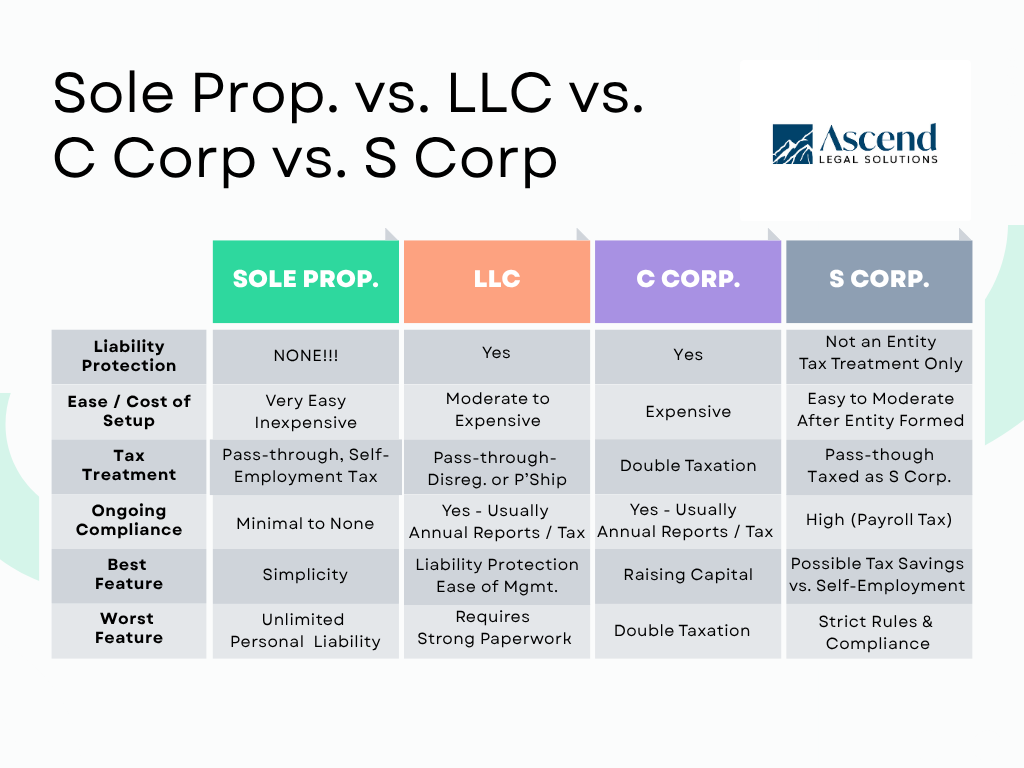
So, your primary takeaways are:
- LLC is the clear winner for liability protection, ease of management and tax flexibility, but it is more expensive to get started than a sole proprietorship.
- The DBA or Assumed Name can be used by any of the entity types as a branding and/or marketing tool.
- The C Corp is the winner for fundraising, but loses out in the other categories.
- The S Corp election is a tax treatment – not a separate entity type. You can even use the S Corp tax election with your LLC.
What Should You Choose?
If you’re just getting started and want to protect yourself without overcomplicating things, a single-member LLC is usually the sweet spot (assuming you don’t have a business partner). It’s more affordable, protects your personal assets, and gives you options for how you’re taxed.
If your business is already making solid profits, talk to a CPA about when it makes sense to elect S Corp tax treatment for your LLC.
And if you’re still running a sole proprietorship—especially without a DBA or liability protection—it may be time to reevaluate before things get messy.
Final Thoughts
Every business is different, and there’s no one-size-fits-all answer (but, in all honesty, the LLC is pretty darn close). But understanding the differences between LLCs, S Corps, C Corps, and sole proprietorships can save you a lot of money and heartache in the long run.
If you’re ready to set up your entity the right way, or you just want to talk through your options, schedule a consultation with an experienced business attorney.
Pro tip: Don’t skip the CPA. A qualified tax advisor who understands your industry is one of the most important investments you can make early on.
Thanks for reading. If this helped you, feel free to share it or leave a comment with questions you’d like me to answer in future posts.
You’ve got this—and we’re here to help.

Leave a Reply